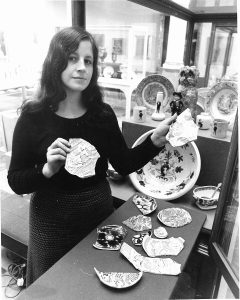
The Calton Weavers Commemoration Committee salutes the life of Elspeth King—a radical curator, uncompromising historian, and fierce defender of the working class. She understood that history is not neutral, that culture is contested terrain, and that those in power will always try to bury the memory of resistance. Elspeth refused to let them.
In a country where museums have too often served the respectable version of events, Elspeth insisted on telling the truth: that Scotland’s history is a history of class struggle.
She confronted head-on the forces — politicians, bureaucrats, cultural gatekeepers —who tried to silence our radical inheritance. She insisted that the past belongs to the people who made it, not to the elites who profit from forgetting.
She was instrumental in defending the memory of the Calton Weavers, murdered in 1787 for daring to organise against exploitation.
Elspeth understood that their story is not a relic—it is a warning, and an example. She placed them firmly within a tradition of defiance: from labour organisers to anti-imperialists and women struggling worldwide for liberation.
Elspeth believed that museums should not be neutral storehouses but sites of struggle. She used her positions — at the People’s Palace, the Stirling Smith, and beyond — to challenge power and defend the voices of those written out of the official story: workers, women, migrants, the poor, and the global victims of empire. When the establishment tried to strip meaning from our institutions,
she fought back. And she paid a price—because she would not compromise.
She taught us that remembrance is not a passive act. To remember the oppressed is to take sides. To honour the dead is to fight for the living. Her work armed generations with knowledge and courage, insisting that history is a tool for organising, for agitation, and for building the world we need.
We honour Elspeth as a comrade in struggle. She confronted power with intellect, imagination, and steel. She exposed the lies that justify injustice, and she guarded the truth that belongs to us all. The thread from the Calton Weavers to the present is not metaphor — it is an instruction. Elspeth kept that thread unbroken. Now it is ours to pull forward with sharpened purpose.
Rest in power, Elspeth. The struggle continues..